There are many variations of cabbage rolls out there, but this tofu cabbage rolls recipe inspired by East Asian flavors is the best, in my opinion of course. These vegetarian cabbage rolls are packed with nutrients and protein, perfect for the whole family.

Ingredients for Tofu Cabbage Rolls
Before making this recipe, make sure you have all of the ingredients you need. All the ingredients are listed below along with possible alternatives. For the best results, stick to the original ingredients.
| Ingredients | Alternatives |
| Napa cabbage | Green cabbage, savoy cabbage |
| Extra firm tofu | Any other variety of tofu |
| White mushrooms | Shiitake mushrooms, baby bella mushrooms |
| Green onions (spring onions) | Chives, leeks |
| Yellow onion | White onion, sweet onion, red onion, shallot |
| Garlic | Garlic powder, jarred garlic |
| Ginger | Ground ginger |
| White rice, any variety | Brown rice, any variety |
| Soy sauce | Dark soy sauce, tamari, liquid aminos, coconut aminos |
| Oyster sauce | Hoisin sauce, vegetarian mushroom sauce |
| Sesame oil | – |
| White sugar | Brown sugar, maple syrup, honey, coconut sugar |
| Canola oil | Olive oil, avocado oil, vegetable oil |
Where to buy
Most of these ingredients can be purchased at your local grocery store. The only exceptions may be napa cabbage, oyster sauce and sesame oil. While larger grocery chains may carry this option, they can be harder to find at smaller grocery stores.
If you can’t find these items at your usual store, try your local Asian grocery store or online at retailers like Weee! and Umamimart.

How to make Tofu Cabbage Rolls
Peel off the large outer leaves of the napa cabbage until you have eight pieces.
Then, steam the leaves of the cabbage for 2-3 minutes or use soft and pliable. Use whatever steaming method you find most convenient.
In a small bowl, combine the soy sauce, oyster sauce, sesame oil and white sugar.
In a large skillet over medium heat, add half of the canola oil. Once hot, add the diced onions, diced mushrooms, chopped green onion, crumbled tofu and white rice.
Add half of the sauce. Stir fry until the vegetables are soft and fragrant.
Then, lay out one cabbage leaf on a flat surface. Add a few spoonfuls of the tofu fillings and roll like a burrito (fold in both sides, then roll). Continue this process with all eight napa cabbage leaves.
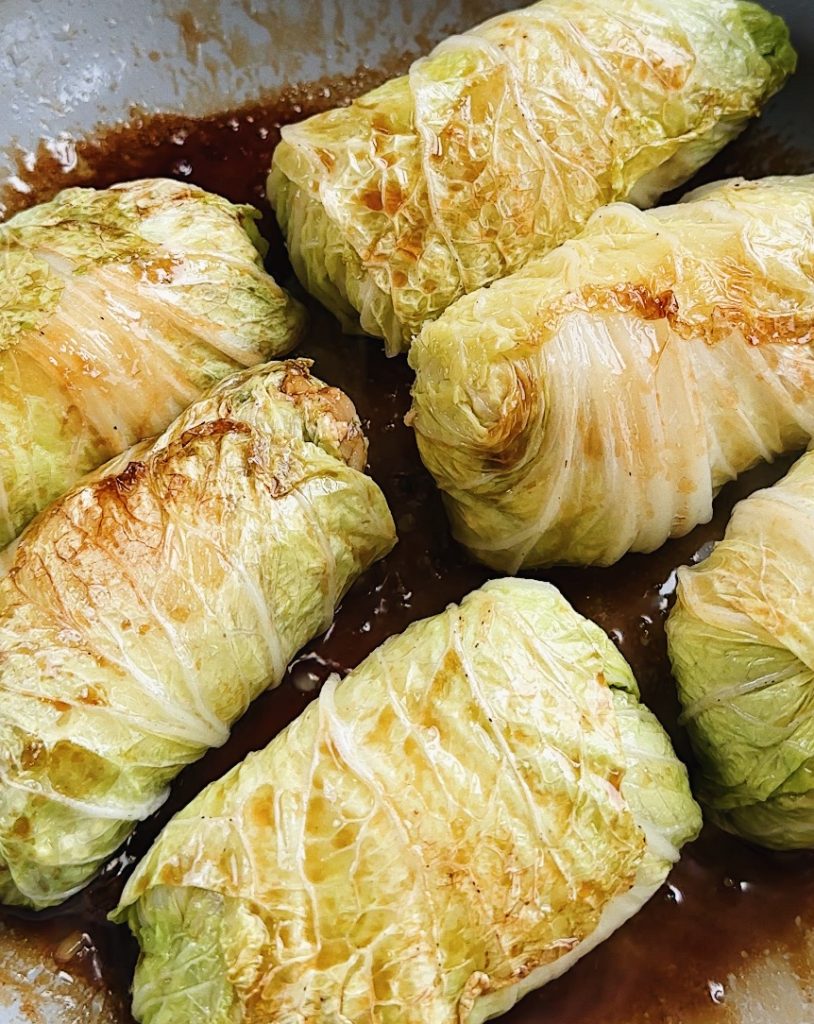
In a large skillet over medium heat, add the canola oil. Place each cabbage roll, open side down, in the skillet. Once one side is browned, flip over. Continue cooking until both sides are browned.
Pour the remaining sauce over the cabbage rolls. Transfer to a plate and enjoy.
How to store the leftovers
If you have any leftovers, transfer them to an airtight container. Make sure to put them away within two hours of completing your meal. They should last about 2-3 days in the refrigerator.
You can also freezer your leftovers. There are a few ways to store them. You can move them to an airtight container, wrap them in plastic wrap or put them in a freezer safe plastic bag. They should last about six months in the refrigerator.
How to make it vegan
This recipe can be very easily turned vegan with one simple ingredient swap. The only non-vegan ingredient in this recipe is the oyster sauce which contains oyster extract.
Swap out this ingredient for vegan oyster sauce, which is typically flavored using shiitake mushrooms. These have a similar flavor to oysters and make for a great substitute.
If you can’t find any vegan oyster sauce near you, you can also replace it with soy sauce, dark soy sauce, hoisin sauce or teriyaki sauce.

Different varieties of cabbage
There are a few different kinds of cabbage that I wanted to highlight in this article. For this recipe, I recommend using napa cabbage, but you can replace it with a different kind of cabbage if you would like. All are equally delicious and high in fiber!
Napa cabbage
Napa cabbage, also known as Chinese cabbage, is commonly consumed in East Asia in countries like China, Korea and Japan. It is large and shaped like an oval, with wrinkly leaves that are thin and delicate.
Recipes that use napa cabbage include kimchi (Korean fermented spicy cabbage), mille-feuille nabe (cabbage and pork hot pot), gyoza (pork and vegetable filled dumplings) and yaki udon (stir fried noodles and vegetables).
You can purchase napa cabbage at your local Asian grocery store. Some larger grocery store chains and health food stores also carry napa cabbage.
Green cabbage
Green cabbage, also known as common cabbage, originates from Europe and was a common consumed staple vegetable in Europe for ages. Since then, the vegetable has gained popularity around the world.
Recipes that use green cabbage include coleslaw (cabbage salad with mayo-based dressing), stuffed cabbage rolls (cabbage leaves filled with ground meat, tomato sauce and rice), colcannon (Irish dish of potatoes and cabbage), and sauerkraut (fermented cabbage).
You can purchase green cabbage at your local grocery store. It’s a very common vegetable and should be easily found anywhere you go. You can also purchase it pre-shredded or in the frozen aisle.
Savoy cabbage
Savoy cabbage originates from Italy. It has a very distinct appearance. It is a dark green color with white wrinkles covering the surface. It’s very wrinkled, similar to napa cabbage.
Recipes that may use savoy cabbage include stuffed savoy cabbage rolls (cabbage leaves filled with ground meat, tomato sauce and rice) and Italian minestrone soup (vegetable soup).
Savoy cabbage may be more difficult to find in your local grocery store compared to green cabbage. You may need to visit a health foods store or international grocery store to find savoy cabbage.
Red cabbage
Red cabbage, also known as purple cabbage, originates from Europe. It is characterized by its vibrant purple or deep red color and is known for its versatility in culinary applications.
Recipes that use red cabbage include coleslaw (cabbage salad with mayo-based dressing), braised red cabbage (slow-cooked with apples, onions, and spices) and pickled red cabbage (fermented with vinegar and seasonings).
While red cabbage is commonly available in grocery stores, it may be more prevalent during certain seasons. Look for it in the fresh produce section, and consider exploring farmers’ markets for a wider selection of cabbage varieties.
Additional Tips
Frequently Asked Questions
What’s the difference between green and napa cabbage?
Green cabbage and napa cabbage are similar in many ways, but have a few distinct differences. Firstly, napa cabbage is typically larger than green cabbage and more oval in shape.
The most noticeable difference between the two kinds of cabbage is the texture of the leaves. Green cabbage is mostly smooth with a few wrinkles. Napa cabbage, on the other hand, is covered in little wrinkles.
Finally, napa cabbage has a white root and seams with light green leaves. Green cabbage, on the other hand, is light green all over until you cut open the cabbage. Then you can see its white core.
Are tofu cabbage rolls healthy for you?
Yes! These tofu cabbage rolls are very nutrient dense and a great way to get in protein as well as your daily dose of vegetables. Plus, they are low in fat and added sugar.
It’s a great source of B vitamins, folate, vitamin A, vitamin C, vitamin E, vitamin K, calcium, iron, magnesium, potassium, selenium and zinc. And that’s all contained in about 300 calories!
Are tofu cabbage rolls vegan?
While the original recipe for these tofu cabbage rolls aren’t vegan, you can easily make them vegan cabbage rolls by swapping the oyster sauce for vegan oyster sauce, soy sauce or hoisin sauce.
Is tofu bad for your hormones?
No, tofu is not bad for your hormones if consumed in moderation. This is true for both men and women. There have been countless studies on this topic. I’ve listed a few meta-analyses and systematic reviews to highlight this topic down below:
- Neither soy nor isoflavone intake affects male reproductive hormones: An expanded and updated meta-analysis of clinical studies
- Systematic Review and Meta-analysis on the Effect of Soy on Thyroid Function
- Clinical studies show no effects of soy protein or isoflavones on reproductive hormones in men: results of a meta-analysis
- Effects of soy protein and isoflavones on circulating hormone concentrations in pre- and post-menopausal women: a systematic review and meta-analysis
Overall, these napa cabbage rolls are filled with protein, vegetables and beneficial nutrients. They are perfect if you are trying to eat healthier or more plant-based. They are great for a weeknight dinner for yourself, you and a friend or a whole family.

Tofu Stuffed Cabbage Rolls with Dipping Sauce
Ingredients
- 8 cabbage leaves
- 2 tbsp canola oil
- 3 green onions chopped
- 1/2 yellow onion diced
- 1 cup mushrooms diced
- 3 garlic cloves grated
- 1 inch ginger grated
- 1/2 block extra-firm tofu crumbled
- 1/2 cup cooked white rice
Sauce
- 2 tbsp soy sauce
- 2 tbsp oyster sauce
- 2 tsp white sugar
- 2 tsp sesame oil
Instructions
- Peel off the large outer leaves of the napa cabbage until you have eight pieces.
- Then, steam the leaves of the cabbage for 2-3 minutes or use soft and pliable. Use whatever steaming method you find most convenient.
- In a small bowl, combine the soy sauce, oyster sauce, sesame oil and white sugar.
- In a large skillet over medium heat, add half of the canola oil. Once hot, add the diced onions, diced mushrooms, chopped green onion, crumbled tofu and white rice.
- Add half of the sauce. Stir fry until the vegetables are soft and fragrant.
- Then, lay out one cabbage leaf on a flat surface. Add a few spoonfuls of the tofu fillings and roll like a burrito (fold in both sides, then roll). Continue this process with all eight napa cabbage leaves.
- In a large skillet over medium heat, add the canola oil. Place each cabbage roll, open side down, in the skillet. Once one side is browned, flip over. Continue cooking until both sides are browned.
- Pour the remaining sauce over the cabbage rolls. Transfer to a plate and enjoy.